To start airbrushing, you need four things bought in this order: a dual action, gravity feed airbrush, a compressor with a tank, airbrush-ready paint and a cleaning setup. A spray booth is optional: it only matters if you paint indoors. This guide gives one pick per step for miniatures and scale models, what each one cannot do, and when you can skip it.
This article contains affiliate links: if you buy through them, we earn a commission at no extra cost to you. As an Amazon Associate we earn from qualifying purchases.
Here is the gear you need to start airbrushing in 2026, in the order you set it up:
- Fengda BD-180 airbrush: dual action, 0.2 mm nozzle for detail.
- Timbertech AS186 compressor: 3 liter tank, motor stops when full.
- Vallejo Model Air set: 16 colors, ready to spray.
- Airbrush cleaning pot: purge jar, holder and brushes.
- Vallejo Airbrush Cleaner: end of session rinse for acrylics.
- Master Airbrush spray booth: optional, sends the mist outside.
- Timbertech AS-186K kit: compressor and airbrush in one box.
What should a beginner decide before buying an airbrush?
Single action or dual action airbrush for a beginner?
A beginner painting miniatures should start with a dual action airbrush: you press the trigger down for air and pull it back for more or less paint, so you go from a thin line to a wide coat without lifting your hand. A single action airbrush only lets the air out, and you set the paint flow beforehand with a knob, which is simpler but cannot change the line width while you spray.
Gravity feed or siphon feed?
For miniatures and scale models, choose a gravity feed airbrush: the cup sits on top, the paint flows down on its own, and a few drops are enough for a session. A siphon feed airbrush pulls paint up from a jar underneath, which suits large surfaces where you need a lot of paint.
How much air pressure do you need to airbrush miniatures?
An airbrush like the BD-180 paints miniatures at around 20 to 30 PSI, so the maximum pressure printed on a compressor listing should not decide your purchase. What matters is the tank: without one, the motor runs the whole session and the air comes out in small pulses that show in your spray; with one, the motor fills the tank, stops, and the air comes out smooth. Our guide to the best airbrush compressor compares more models.
The airbrush starter gear, step by step
Step 1: Fengda BD-180, the dual action airbrush for detail work
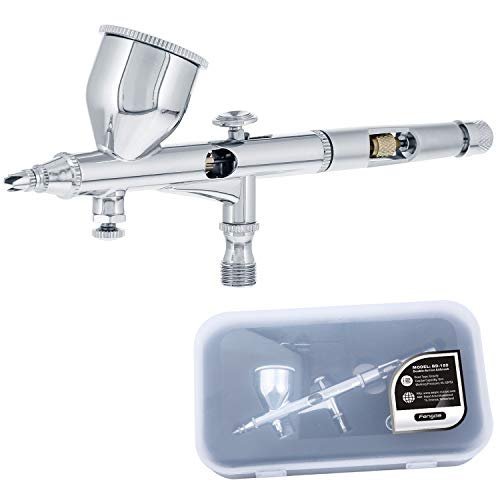
- Type: dual action, gravity feed
- Nozzle: 0.2 mm, four-piece head
- Cup: 9 ml
- Adjustments: air valve on the head, trigger stop at the back
- Working pressure: 20 to 30 PSI for miniatures
- Price: $54.00 on Amazon (November 20, 2026)
The 0.2 mm nozzle, the tiny tip the paint comes out of, is fine enough for the details of a miniature. The trigger stop, a small screw at the back, keeps you from pulling the trigger too far and flooding the miniature with paint. The BD-180 is a detail airbrush: with a 9 ml cup and a single fine nozzle, it is slow on large surfaces, and the listing mentions no hose, so plan one to connect it to the compressor.
Check the Fengda BD-180 price on Amazon
Our take: the right first airbrush for miniatures and scale models; skip it if you mostly paint large surfaces, where a 0.3 or 0.5 mm nozzle covers faster. To compare other models, read how to choose an airbrush.
Step 2: Timbertech AS186, the compressor with a 3 liter tank
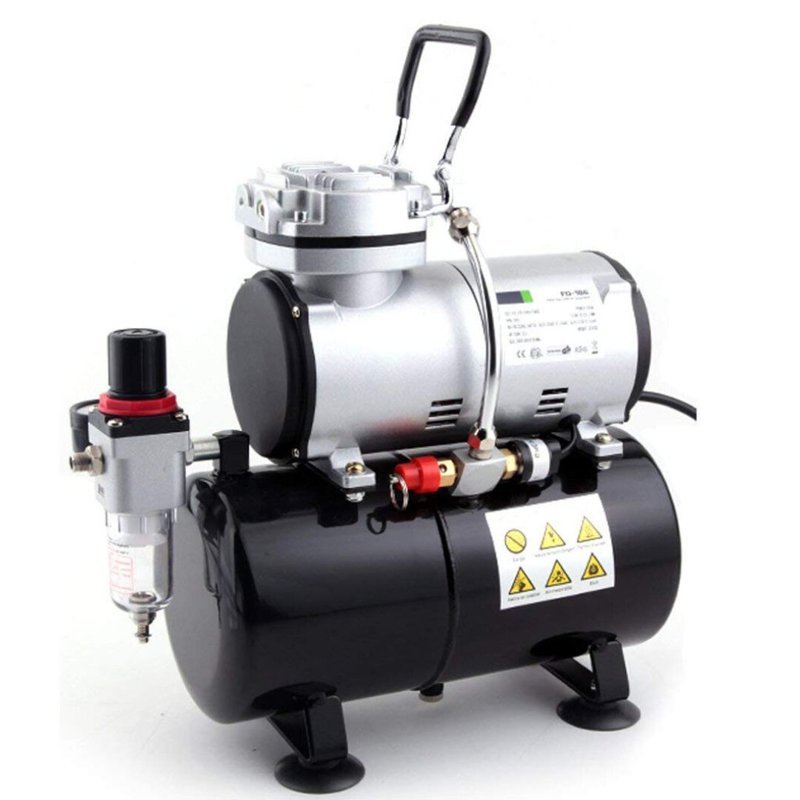
- Tank: 3 liters
- Auto start at 3 bar (about 43 PSI), auto stop at 4 bar (about 58 PSI)
- Air flow: 20 to 23 L/min, oil-free 1/6 HP piston
- Regulator with gauge, moisture trap and air filter
- Noise: 47 dB announced on the listing
- Price: $87.99 on Amazon (November 20, 2026)
The Timbertech AS186 fills its 3 liter tank, then the motor stops and only restarts when the pressure drops, so it does not run nonstop and heats less. The regulator sets the pressure, the gauge shows it, and the moisture trap catches water from the air before it spits into your paint. With 47 dB announced and a motor that stops when the tank is full, it suits evening sessions in an apartment; it is still the most expensive piece you actually need, and pointless for two sessions a year.
Check the Timbertech AS186 price on Amazon
Our take: the tank is what makes one-hour sessions comfortable, and the AS186 is the compressor of the AS-186K kit below, so both paths lead to the same air supply.
Step 3: Vallejo Model Air Basic Colors, the airbrush-ready paint set
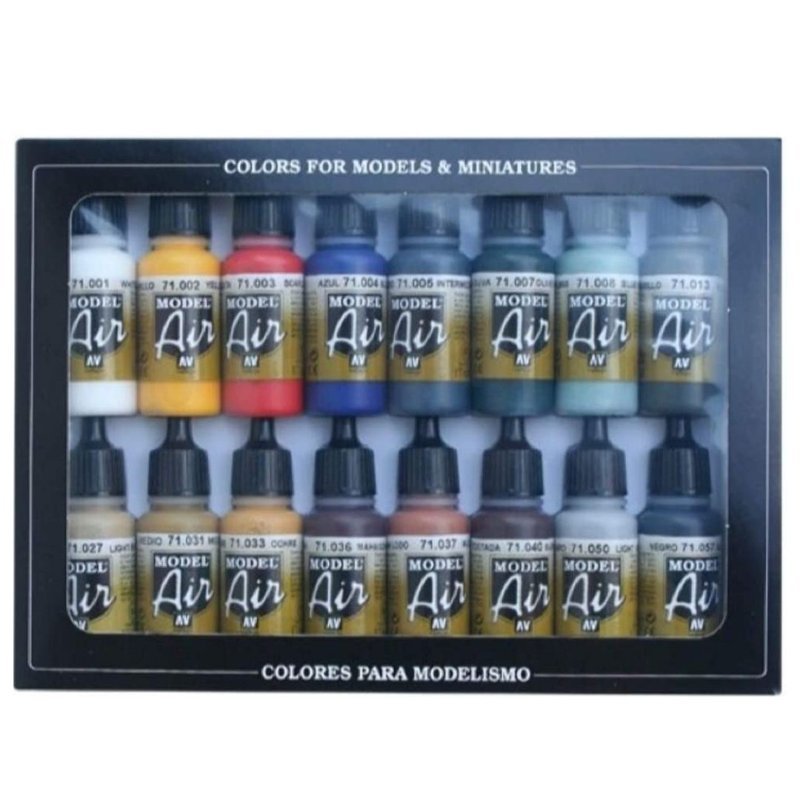
- Reference: Vallejo 71.178 Basic Colors
- Content: 16 dropper bottles, 17 ml each
- Type: acrylic, pre-thinned for the airbrush
- Price: $47.48 on Amazon (November 20, 2026)
Brush paint is too thick for an airbrush: it clogs the nozzle and the airbrush starts to spit. Vallejo Model Air is already thinned, so you pour it straight into the cup and measure drop by drop, and the 16 colors mix into new ones. It is a basic palette designed for scale models, with no washes, and because it is pre-thinned it is too runny for brush work.
Check the Vallejo Model Air set price on Amazon
Our take: the safest way to make your first session work without learning to thin paint on the same day; if you already own many brush paints, an airbrush thinner is enough to start (see the FAQ for the ratio). More options in our guide to the best airbrush paints.
Step 4: Airbrush cleaning pot, the purge jar with holder and tools
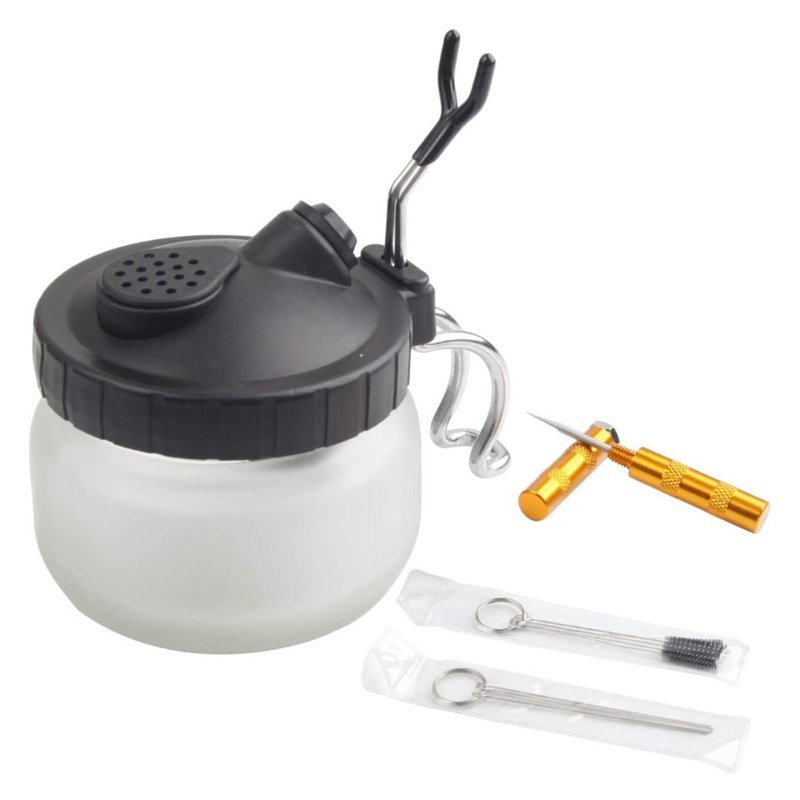
- Jar: thick glass, 304 ml, vented lid with filter
- Holder: hook that holds the airbrush on the pot
- Tools: 5 needles, 5 brushes from 2 to 5 mm, 1 wash needle, 1 nozzle wrench
- Spares: 2 filter pads
- Price: $13.99 on Amazon (November 20, 2026)
An airbrush that is not rinsed properly clogs up by the next session. The cleaning pot lets you spray the leftover color into a glass jar instead of into the room, and its hook keeps the airbrush from rolling across the table. The filter pads in the lid get dirty and need replacing, and the pot does not replace a full teardown of the airbrush now and then.
Check the cleaning pot price on Amazon
Our take: the accessory you will use at every color change, with 4,786 Amazon ratings at 4.7 out of 5; skip it only if you already have a cleaning station.
Step 5: Vallejo Airbrush Cleaner, the end of session rinse
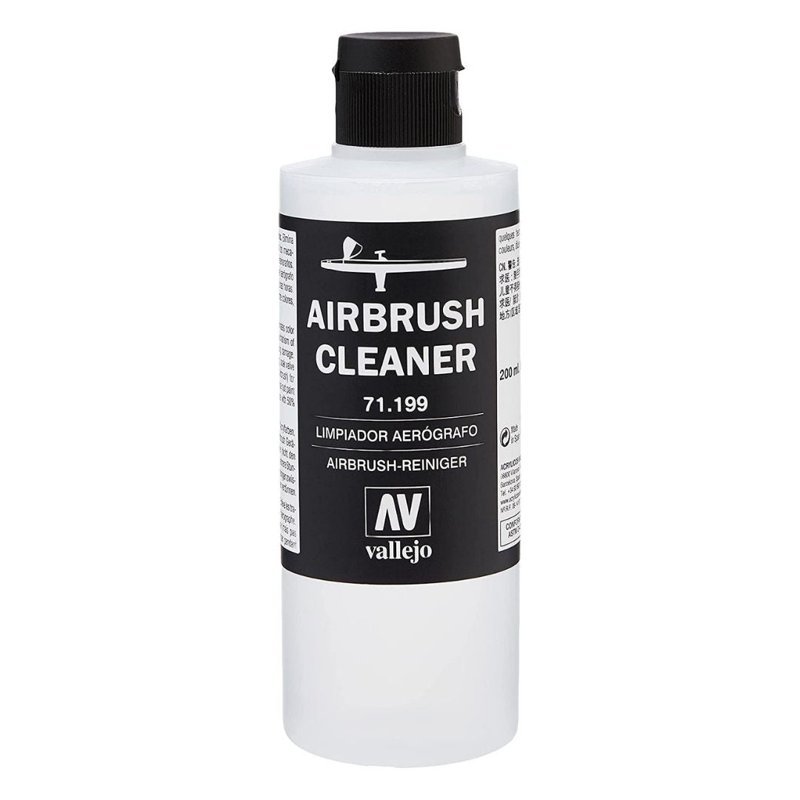
- Reference: Vallejo 71.199
- Volume: 200 ml
- Use: acrylic paints, removes dried pigment and lubricates the mechanism
- Price: $12.28 on Amazon (November 20, 2026)
Vallejo Airbrush Cleaner loosens the pigment stuck in the cup and the nozzle, and lubricates the needle on the way. 200 ml goes fast if you rinse with it at every color, so rinse with water between colors and keep the cleaner for the end of the session. It is made for acrylics and does nothing for solvent-based paints, which need their own thinner.
Check the Vallejo Airbrush Cleaner price on Amazon
Our take: the cheapest insurance against a clogged nozzle if you paint with acrylics; the full routine is in our guide on how to clean an airbrush.
Optional: Master Airbrush B2000, the folding spray booth
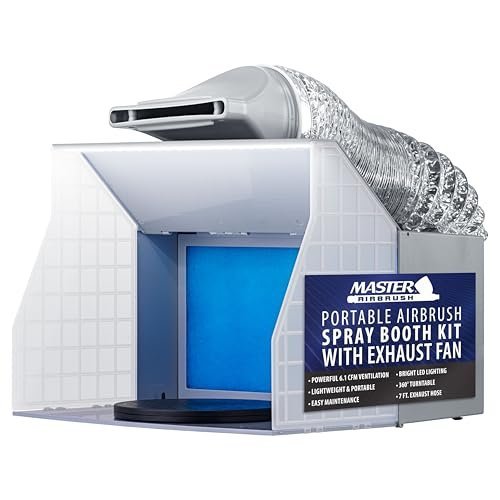
- Ventilation: 6.1 CFM announced, two-layer fiberglass filter
- Exhaust hose: up to 7 feet, flat window adapter
- LED light and 7.5 inch turntable
- Noise: 60 dB announced
- Price: $99.99 on Amazon (November 20, 2026)
Part of the paint never lands on the miniature: it turns into a fine mist that settles on your furniture. The Master Airbrush booth pulls that mist through a filter and sends it out a window through its hose, lights the piece and lets you turn it without touching it, then folds into a carrying case. Its 6.1 CFM suit small pieces, not a car body, the 7 foot hose has to reach a window, and it now costs more than the compressor.
Check the Master Airbrush booth price on Amazon
Our take: worth it if you paint in a bedroom or a living room, useless if you paint outdoors or in a ventilated garage.
The cheaper path: Timbertech AS-186K, compressor and airbrush in one kit
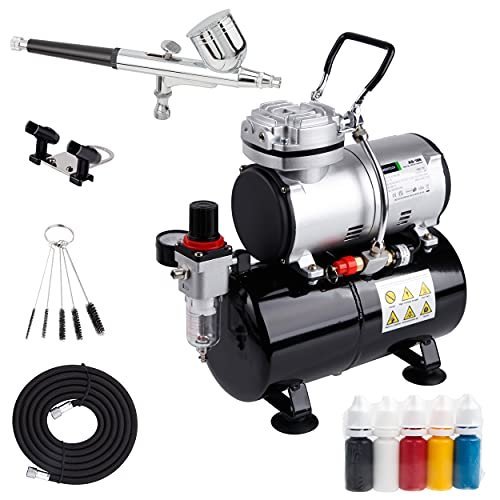
- Compressor: the same AS186, 3 liter tank
- Airbrush: dual action, gravity feed, single 0.3 mm nozzle
- Included: 6 foot hose, cleaning brush, holder, 5 paints
- Missing: cleaning pot, cleaner, 0.2 mm nozzle, a full paint set
- Price: $104.99 on Amazon (November 20, 2026)
If you have nothing yet, the Timbertech AS-186K puts the AS186 compressor, a dual action airbrush and a hose in one box for close to $40 less than the BD-180 and the compressor bought separately. Its airbrush is not the BD-180: the single 0.3 mm nozzle covers faster for primer coats but is less precise on small details. With no cleaning pot, no cleaner and only five paints, you still need steps 3, 4 and 5.
Check the Timbertech AS-186K kit price on Amazon
Our take: the cheapest way to start from zero; skip it if you already own an airbrush or a compressor, because you would pay for it twice.
Airbrushing for beginners: FAQ
How do you thin brush paint for an airbrush?
Add one to two drops of airbrush thinner for ten to twelve drops of brush paint, then mix until the paint is about as thick as milk. Too thick, it clogs the nozzle and spits; too thin, it runs on the miniature. Test on paper before touching the model.
How do you clean an airbrush between two colors?
Empty the cup into the cleaning pot, add a little water and spray it into the pot until it comes out clear, then load the next color. At the end of the session, do the same rinse with airbrush cleaner, so the bottle lasts longer and the nozzle stays clean for the next time.
Do you need a hose to connect an airbrush to a compressor?
Yes: the BD-180 listing mentions no hose, so buy one with the airbrush, and check that its fittings match both the airbrush and the compressor outlet. The Timbertech AS-186K kit includes a 6 foot hose.
Do you need a mask to airbrush indoors?
Yes: airbrushing turns paint into fine particles you can breathe in, even with water-based acrylics. Wear a mask with particle filters for acrylics and a respirator with organic vapor cartridges for solvent-based paints, and add a spray booth or an open window when you paint inside.
Can you airbrush in an apartment?
Yes, with a tank compressor and some ventilation: the Timbertech AS186 is rated at 47 dB and stops once its tank is full, and a booth with a hose to the window takes the paint mist out of the room.
What should you practice on first?
Start on paper or card: draw lines, dots and gradients to learn the dual action trigger at 20 to 30 PSI before painting a miniature. Our tutorial on how to use an airbrush walks through the first exercises.